

Two summers ago, Guerschon Yabusele was a $2.1 million bargain for the Philadelphia 76ers, signed on a one-year deal after his Olympic final against the United States. This summer, after a season split between the Knicks and Bulls, Panathinaikos gave him €12.6 million over three years, one of the three biggest contracts in European basketball. Philadelphia, meanwhile, signed LeBron James for $8 million over two years.
Per season, Europe is now paying Yabusele about what the NBA’s most famous player will earn in Philadelphia. That sounds like a money race closing in. Look past the stars to the payrolls around them, and the distance between Europe and the NBA is as wide as it has ever been.
Where Europe’s money race stands
The European money is real. As this site’s series on the economics of the game has set out, average EuroLeague club revenue has reached €22.3 million, up 14%, club values have risen 40% in three years and a €30 million annual spend is now common at the top. Panathinaikos lead the 2025-26 player-budget table at an estimated €26.5 million to €27 million after tax, ahead of Olympiacos at €22 million to €22.5 million and the newcomers Hapoel Tel Aviv and Dubai.
So is the bill. Panathinaikos lost about €43 million on €32 million of revenue in 2023-24 before cutting that to a €2.5 million loss on €42 million in 2025-26. Olympiacos lost €16.6 million on €25.5 million in 2024-25.
Some clubs have stepped off the treadmill. JL Bourg turned down a EuroLeague place rather than stretch a town of 42,000 and a 3,548-seat gym, and Unicaja Malaga and Alba Berlin left for the Basketball Champions League and kept winning trophies. “Valencia Basket cannot engage in multi-million dollar bidding wars,” general manager Enric Carbonell said.
The NBA case study: Philadelphia
Philadelphia’s summer started with a trade. On 6 July, the 76ers sent Paul George, two first-round picks and two second-round picks to Boston for Jaylen Brown. James followed on his two-year, $8 million deal, a price set as much by the NBA’s rules as by his own wish to chase a title. Having used their mid-level exception, the 76ers were hard-capped and could offer no free agent more than a minimum contract without first shedding salary.
The result is a $205.6 million payroll for 2026-27, $5.2 million over the luxury tax line and just under the first apron. Joel Embiid ($58.0 million) and Brown ($57.7 million) each earn more than Panathinaikos spends on its whole squad, on the after-tax figures European clubs report, and Tyrese Maxey adds $40.8 million. The full payroll is more than four times Panathinaikos’ total club revenue. Expectations moved with the money. A team that won 45 games last season, beating a preseason total of 43.5, now carries a win total of 50.5 and is priced among the Eastern Conference favorites. “I didn’t leave my family to lose in the second round,” James said at media day.
Does money buy wins?
Philadelphia’s own record says not reliably. Since 2018-19, the 76ers have started four full seasons with 50.5 or more. Philadelphia’s win total record shows they went over twice, with 51 wins in 2021-22 and 54 in 2022-23, and under twice: 51 against 53.5 in 2018-19 and 24 against 50.5 in 2024-25. A fifth, 2019-20, was cut short by the pandemic, with the 76ers on 43 wins against a total of 54.5.
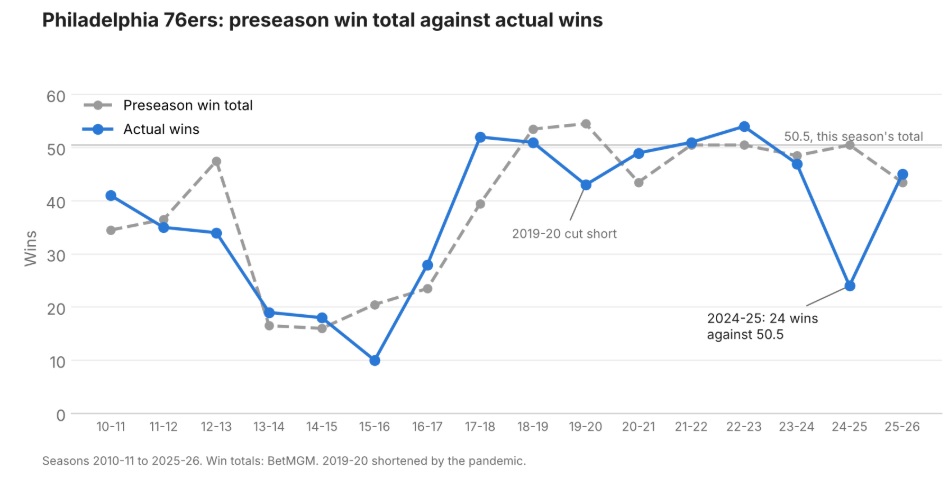
Chart Source: 76ers Win Total
2024-25 is the warning. Paul George arrived on a max contract, Embiid played 19 games and a roster built to contend won 24, more than 26 below its number. Yabusele was on that team, and one of the few cheap contracts that worked.
Europe has its own version of the lesson. Fenerbahce won the 2025 EuroLeague while losing €4 million to €5 million, and Unicaja has won two Basketball Champions League titles and two Copas del Rey since leaving the EuroLeague in 2021.
Why Europe can’t simply copy it
Philadelphia operates inside a closed league with a salary cap, a luxury tax, and two aprons that limit what any team can add, plus national television money shared across 30 teams. European clubs have none of that machinery on the same scale. No draft hands the weakest teams the best young players. Domestic leagues still run on promotion and relegation, so a club chasing a EuroLeague title must also survive a national season against opponents with a fraction of its budget. Arenas are the other gap: Panathinaikos and Olympiacos have only now secured 49-year arena deals, while JL Bourg plays in a gym that seats 3,548.
What NBA Europe could change
The NBA’s planned European league could change the scale. It plans 16 teams from 2027, 12 permanent franchises and four qualifiers, with bids sought at $500 million to $1 billion a franchise and more than 20 ownership groups bidding by the 30 June deadline.
On 5 October, EuroLeague’s shareholder clubs unanimously rejected the NBA’s opening proposal and put their own expansion on hold, though both sides say talks will continue.
If franchises sell near those prices, a handful of European clubs would have NBA-scale owners for the first time, and the clubs left outside would face a wider gap than they do now.
The gap that matters
Europe has closed the distance at the top of the pay scale far enough that a EuroLeague club can outbid the NBA for a player like Yabusele. It is nowhere near what surrounds the star: a $205.6 million payroll, a league built to share its revenue, and owners willing to pay the tax. And Philadelphia’s own history says even all of that buys a 50.5-win expectation, with no guarantee attached.




Leave a Reply